7 AI Predictions 2026: ChatGPT, Gemini, and Claude Compared
Consensus AI predictions 2026 suggest a pivotal metamorphosis from visible, reactive tools to ambient, invisible infrastructure. Models like ChatGPT, Gemini, and Claude forecast a trajectory where AI ceases to be a chatbot you visit and becomes a proactive autonomous agent woven into your daily existence. This transition signals the rise of an intelligent operating system capable of managing multi-step logistics, context-aware assistance, and hyper-personalized media generation without manual intervention.
Picture yourself in a grocery store, paralyzed by dinner indecision. Instead of searching your memory or your phone, your device provides a subtle nudge: “You have spinach, but you’re out of heavy cream for that pasta recipe you made last week.” This isn’t a speculative pipe dream; essentially, it is the specific flavor of context-aware assistance labs expect to be ubiquitous by next year. The friction of constant data entry is fading, replaced by a layer of intelligence that anticipates your requirements before they even register in your mind.
Nevertheless, the shift from “chatting with a bot” to “living with an agent” remains the era’s defining challenge. You won’t open a separate app for assistance because the help is already baked into your workflow. While this offers immense productivity gains, it also introduces a fresh set of hurdles regarding personal agency and the opaque nature of automated logic. Navigating this landscape requires a firm grasp of where the major AI labs find common ground and, conversely, where their roadmaps for your future diverge.
The Core Consensus: Autonomous Agents as Infrastructure
The consensus across major labs is that AI will become “invisible infrastructure” rather than a destination. This means you’ll eventually stop saying you are “using AI” and simply execute tasks powered by AI predictions 2026. This ambient software layer stays in the background, surfacing only when an intervention is required. Such a shift is driven by the maturation of multimodal AI, which processes text, audio, and visual data simultaneously without needing separate prompts for every input.
Meanwhile, a major point of agreement is the rise of the “proactive operator.” Instead of waiting for a request, these systems observe your environment. If a meeting is canceled, your agent won’t just notify you; besides informing you, it will offer to reschedule your gym session or suggest a client call based on the newly opened slot. This requires integration moving beyond simple API calls into deep, system-level access. You can see early versions of this today by observing how Gemini in Google Docs organizes content based on broad project themes rather than just autocomplete.
The practical application of this roadmap is the logistics manager model. Imagine planning a business trip where your assistant already knows your budget, flight preferences, and dietary needs. It doesn’t present a list of flights; it books the ticket, reserves your favorite hotel, and files the expense report before you even board. This level of autonomous agents integration requires high trust, but the trade-off is often a loss of transparency. If the AI picks a specific restaurant, you might not know if it was based on your history or a sponsored placement in the “black box” of its algorithm. To help you prepare, the following chart outlines the high-probability milestones predicted for the next 24 months:
| Milestone | Probability | Impact |
|---|---|---|
| Autonomous Agent Proactivity | 90% | High |
| Real-time Multimodal Context | 85% | Very High |
| Ubiquitous Edge AI | 70% | Medium |
| Human-level Reasoning (AGI) | 30% | Extreme |
Automating the Digital Chore List
By late 2026, the following tasks are projected to be largely automated for professional users. You should identify your top three repetitive daily tasks—such as filing expenses or inbox triaging—now, as these are where the immediate impact will hit:
- Calendar Orchestration: Autonomous rescheduling across disparate platforms and time zones.
- Synthesis & Action: Real-time meeting summaries that automatically assign tasks in project trackers.
- Complex Procurement: Reordering supplies by tracking consumption patterns without manual inventory checks.
- Vendor Logistics: Comparing quotes for repairs or travel and presenting a final recommendation for a one-click approval.
The Conflict Matrix: Where Tech Giants Diverge
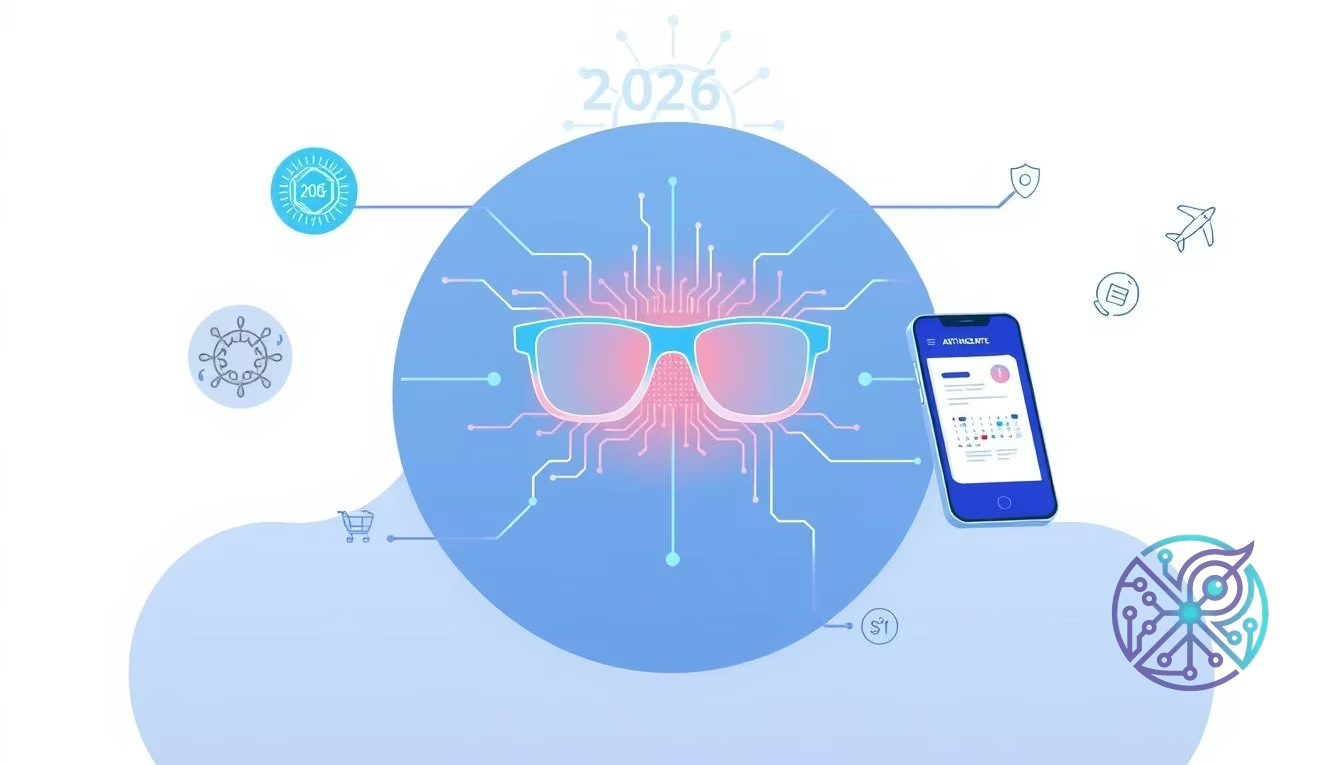
While the three major chatbots agree on ambient intelligence, they diverge sharply on your interaction model and the inherent risks. ChatGPT emphasizes a subtle psychological shift where users might lose agency as AI handles micro-decisions. Gemini focuses on structural changes, such as the death of the search bar and the rise of smart glasses. Claude highlights the “saturation” aspect, focusing on how AI quietly understands your physical environment, like identifying a specific medication on your counter.
These divergence points are critical because they reflect the distinct AI chatbot predictions coming from OpenAI, Google, and Anthropic. The following table breaks down these “Conflict Points” to help you understand which vision of 2026 might impact your specific workflow more heavily:
| Conflict Point | ChatGPT (OpenAI) | Gemini (Google) | Claude (Anthropic) |
|---|---|---|---|
| User Control | Risk of “choice fatigue” and loss of personal agency. | Focus on “proactive action” with minimal user touch. | Passive awareness that users eventually accept for convenience. |
| Interface | Embedded in existing apps; no “destination” tool. | Augmented reality via glasses and synthesized answers. | Multi-app coordination and contextual environment sensing. |
| Discovery | Summaries replace original content; skepticism grows. | Search becomes a “black box” without external links. | AI joins meetings and listens for specific opportunities to help. |
You must choose your ecosystem based on these predicted behaviors. OpenAI’s ChatGPT 2026 roadmap focuses on deep integration into Apple and Microsoft, making the bot an inseparable part of your OS. Google’s Gemini AI future 2026 is more about hardware-software symbiosis. Conversely, Anthropic’s Claude 3.5 predictions suggest a focus on high-reliability agents for complex, multi-document analysis. If you value seeing original sources, the “black box” of Gemini might be a disqualifier, yet if you want a system that guides you through physical repairs via smart glasses, Google is the clear leader.
The Logic Gap: Reasoning vs. Imitation
The question of Artificial General Intelligence (AGI) remains debated, but the focus for 2026 has shifted from “can it think” to “how well can it reason.” You will notice a transition from models that simply predict the next token to systems with verifiable internal logic. These models use techniques like chain-of-thought processing and internal verification to catch errors before presenting an answer. While you may not meet a single entity that thinks exactly like a human, you will use autonomous agents that perform specialized tasks with near-human reliability.
Technical evidence for this progress is found in the scaling laws for large language models, showing that data quality yields significant gains in logic. However, these gains are hitting physical walls. The energy consumption required for training is forcing labs toward more efficient architectures, such as “Mixture of Experts” or smaller, specialized models that run locally. This edge AI approach allows for faster reasoning without the latency of cloud queries.
You can see the difference between simple imitation and actual logic by taking a thinking vs imitation test to evaluate your current tools. In 2026, the gap between a model that looks smart and one that is reliable will widen. Professional workflows will move toward “closed-loop” systems. For example, an AI in a legal firm won’t just summarize a document; it will check the summary against current case law, verify the citations, and flag potential conflicts—all before a human even sees the first draft.
“The transition from LLMs that generate text to agents that execute logic is the most significant shift since the transformer architecture was first introduced.” — Official Research Documentation, OpenAI
Visual Fidelity: The End of Stock Media
By 2026, the boundary between “generated” and “real” media will be functionally non-existent. The primary change isn’t just higher resolution, but the move toward hyper-personalized environments. Instead of a generic ad, you might see a video featuring a digital version of yourself demonstrating a product in a kitchen that looks exactly like your own. This is made possible by synthetic data and multimodal AI that instantly adapts visual content to fit your specific aesthetic preference.
For creators, this means the death of traditional stock photography. You won’t search for an image; you will describe the exact scene you need, and the AI will generate it with perfect lighting. If you’re looking to save time on brand assets, you might already use free AI headshot generators for studio-quality portraits. By 2026, this capability will extend to full-motion video, allowing for the creation of marketing clips in seconds. Nevertheless, this ease of creation sparks a massive surge in deepfakes, necessitating mandatory digital watermarking baked into the model architecture.
Checklist for visual AI in 2026:
- Temporal Consistency: AI videos will no longer have “jitter” or shifting textures between frames.
- Interactive Assets: 3D models generated from text for virtual reality or gaming.
- Visual Context Awareness: Smart glasses overlaying a 3D repair manual on a broken appliance.
- Personalized Learning: Educational videos that adapt visual metaphors based on your specific interests.
The Physical Wall: Hardware, Safety, and Energy
Claude and Gemini both predict that 2026 will be the year AI “escapes the screen.” You will see a shift toward edge AI, where processing happens locally on your device. This allows for “ambient vision,” where the AI provides real-time info about what you see without an upload delay. For example, an assistant like Granola AI already listens quietly and speaks only when asked. In 2026, this becomes more integrated; your phone might remind you of a prescription refill because it “saw” the bottle in a photo, or update a tracker because it heard you agree to a deadline.
As we push toward these AI predictions 2026, we must confront physical reality. The massive growth of these models is limited by energy consumption and high-quality data availability. Since most human-generated text has been used, labs are turning to synthetic data—AI training AI. This scaling risks “model collapse” if systems start learning from their own errors. Simultaneously, the environmental impact of data centers is becoming a central political issue, driving a shift in OpenAI model updates toward efficiency-first designs.
The 2026 landscape isn’t about one giant breakthrough; it’s about gradual saturation. AI will be in your glasses, your grocery list, your work meetings, and your media feeds. The challenge is ensuring these tools give you more freedom, not less, by keeping you in the loop. Use local models where possible to enjoy ambient features without sacrificing privacy. By setting these digital boundaries now, you’ll be prepared for a 2026 where AI is invisible, proactive, and genuinely useful, rather than intrusive and overwhelming.
To stay ahead in 2026, you must transition from treating AI as a search tool to managing it as a strategic partner. Start by identifying three core administrative tasks that drain your mental energy and delegating them to the current generation of agents to build your workflow baseline. While the technology moves toward ambient, ‘invisible’ infrastructure, your role shifts to one of oversight—setting clear policy guardrails for your digital assistants to ensure they align with your personal and professional values before autonomy becomes the default. The future isn’t about the bot; it’s about the time you regain once the bot becomes invisible.
FAQ
What is the most significant AI milestone expected by 2026?
The defining shift is the transition to proactive autonomous agents that execute multi-step logistics without constant prompting. You’ll see AI moving from simple Q&A tools to handling entire workflows, like end-to-end travel coordination or expense management, independently.
Will AI replace search engines by 2026?
Traditional search is evolving into synthesized answer engines that compile data from multiple sources instantly. While the list of blue links is fading, you’ll still use these platforms for discovery—though the ‘black box’ nature will require you to be much more vigilant about citation checking.
How will AI impact my daily privacy in 2026?
Privacy risks will shift toward ‘ambient awareness’ as devices process your physical surroundings in real-time. To protect yourself, prioritize ‘edge AI’ tools that keep your data on your phone or glasses rather than uploading every observation to the cloud.
Can I trust AI to make financial decisions for me in 2026?
AI will excel at routine procurement and price comparisons, but you should maintain a ‘one-click approval’ protocol. This allows the agent to handle the heavy research and logistics while ensuring you remain the final decision-maker for any actual expenditure.
What is the ‘Conflict Matrix’ in AI predictions?
The Conflict Matrix tracks the fundamental disagreements between OpenAI, Google, and Anthropic regarding future AI capabilities. These typically center on user agency, the role of wearable hardware, and whether AI should be a visible assistant or an invisible system layer.